Laser guide star systems create artificial light points, aiding telescopes in correcting atmospheric distortions for clearer observations, revolutionizing astronomy and related fields.
What is a Laser Guide?
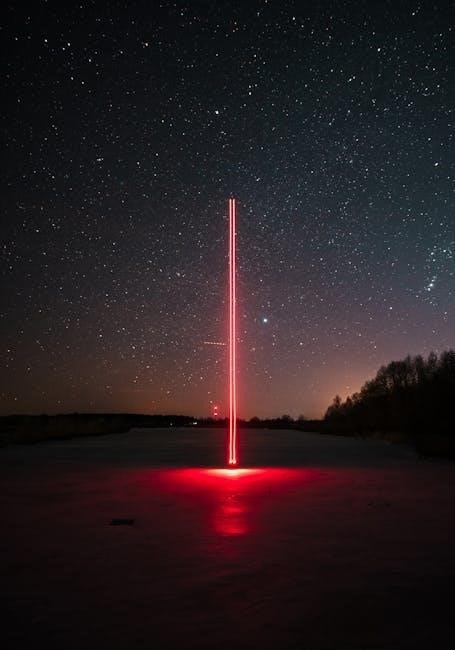
A laser guide is a sophisticated technological tool employed to generate an artificial star in the Earth’s atmosphere. Unlike natural stars, these artificial beacons are created by projecting a powerful laser beam into the sky, typically targeting layers containing sodium atoms or utilizing Rayleigh scattering.
This artificial “star” provides a known reference point for telescopes, enabling them to overcome the blurring effects of atmospheric turbulence. The laser’s focused beam excites atoms in the upper atmosphere, causing them to emit light, effectively creating a bright spot that appears as a star. This allows astronomers to achieve significantly sharper images and more precise measurements, unlocking new possibilities in astronomical observation and research. It’s a controllable and reliable calibration source.
Historical Development of Laser Guide Technology
The concept of correcting atmospheric distortion dates back decades, but the realization of laser guide stars began in the 1980s. Initial research focused on creating artificial beacons to improve astronomical imaging. Early attempts faced challenges in laser power and atmospheric effects.
A significant breakthrough came with the development of sodium laser guide stars, utilizing the resonant excitation of sodium atoms in the mesosphere. The first successful demonstration of a sodium laser guide star system occurred in the 1990s, marking a pivotal moment. This technology rapidly advanced, becoming integral to major observatories.

Further refinements included Rayleigh laser guides and advancements in adaptive optics, continually enhancing image quality and expanding the scope of astronomical observation. The Extremely Large Telescope builds upon this legacy.

Types of Laser Guides
Laser guides encompass sodium, Rayleigh, and constellation varieties, each employing distinct atmospheric excitation methods to generate artificial reference points for optical systems.
Sodium Laser Guide Stars
Sodium laser guide stars represent a prominent technique, utilizing lasers tuned to excite sodium atoms naturally present in the Earth’s mesosphere, approximately 90 kilometers high. This excitation creates a bright, localized point of light mimicking a distant star, providing a crucial reference for adaptive optics systems.
The advantage of sodium guides lies in their relatively narrow emission layer, resulting in a well-defined artificial star. However, they are susceptible to “tip-tilt” aberrations, requiring additional correction mechanisms. Systems like TOPTICA’s SodiumStar demonstrate high-resolution space observation capabilities, imaging spacecraft and debris effectively. These stars are vital for mitigating atmospheric turbulence, enabling sharper astronomical images and precise tracking of objects in orbit. Ongoing advancements focus on enhancing stability and minimizing aberrations for even greater precision.
Rayleigh Laser Guide Stars
Rayleigh laser guide stars operate by backscattering laser light directly from atmospheric molecules, primarily nitrogen and oxygen, across a broader altitude range compared to sodium guides. While simpler to implement, this method produces a less defined guide star due to the extended scattering volume. Consequently, Rayleigh guides are more prone to distortions caused by atmospheric turbulence within that volume.
To overcome this limitation, sophisticated techniques like wavefront sensing and reconstruction are employed to characterize and correct for these aberrations. Despite the challenges, Rayleigh guides offer advantages in certain scenarios, particularly when sodium layer conditions are unfavorable. They provide a valuable alternative, contributing to the overall versatility of adaptive optics systems and enhancing observational capabilities across diverse atmospheric conditions. Further research aims to refine Rayleigh guide star technology for improved performance.
Constellation Laser Guides
Constellation laser guides represent a relatively newer approach, utilizing multiple laser guide stars projected across a wider field of view to create a more comprehensive atmospheric correction map. Unlike single guide stars, which provide localized correction, constellation guides aim to mitigate atmospheric turbulence over larger areas of the sky. This is particularly beneficial for wide-field imaging and surveying, enabling observations of extended astronomical objects with improved clarity.
Implementing constellation guides requires complex control systems and advanced algorithms to manage and combine the information from multiple laser projections. The increased computational demands are offset by the significant gains in sky coverage and image quality. This technology is poised to become increasingly important with the advent of extremely large telescopes, demanding more sophisticated atmospheric correction techniques for optimal performance and scientific discovery.

How Laser Guides Work
Laser guide star systems project artificial light into the atmosphere, providing telescopes with a stable reference point to counteract distortions caused by air turbulence.
Creating Artificial Stars
Laser guides don’t rely on naturally occurring stars; instead, they create artificial ones. This is achieved by projecting a powerful laser beam into the upper atmosphere, typically around 90 kilometers high. The method used depends on the type of guide star.
Sodium laser guide stars excite sodium atoms present in a natural layer of the atmosphere, causing them to resonate and emit light – effectively creating a bright, pinpoint “star.” Rayleigh laser guide stars, conversely, utilize a laser that scatters off atmospheric molecules.
These artificial stars serve as crucial reference points for adaptive optics systems, allowing telescopes to compensate for the blurring effects of atmospheric turbulence and achieve exceptionally sharp images. The process is fundamental to modern astronomical observation.
Atmospheric Distortion Correction
Earth’s atmosphere introduces significant distortions to incoming light from space, causing stars to twinkle and blurring astronomical images. Laser guides play a vital role in mitigating these effects. By analyzing the light from the artificially created star, telescopes can precisely measure the atmospheric turbulence in real-time.
This data is then fed into adaptive optics systems, which adjust the telescope’s mirrors – often hundreds of times per second – to counteract the distortions. Essentially, the system creates a “reverse image” of the atmospheric turbulence, effectively canceling it out.
The result is dramatically sharper and clearer images, comparable to those obtained from telescopes in space, but at a fraction of the cost. This correction is essential for high-resolution astronomical observations.
Adaptive Optics Integration
Laser guides aren’t effective in isolation; their true power lies within integration with adaptive optics (AO) systems. AO systems are complex technologies that dynamically correct for atmospheric distortions, utilizing the information provided by the laser-created artificial star.
The light from the guide star is analyzed by a wavefront sensor, which measures the distortions introduced by the atmosphere. This data is then processed by a real-time control system that commands deformable mirrors within the telescope to adjust their shape.

These mirrors, capable of minute adjustments, counteract the atmospheric turbulence, effectively “undoing” the blurring effect. This integration allows ground-based telescopes to achieve image quality rivaling, and sometimes exceeding, that of space-based observatories, opening new frontiers in astronomical research.

Applications of Laser Guides
Laser guides enhance astronomy, space situational awareness, and optical satellite communications, providing crucial calibration and enabling high-resolution observations of space objects.
Astronomy and Telescope Calibration
Laser guide stars fundamentally transformed astronomical observation by overcoming the limitations imposed by Earth’s atmosphere. Prior to their development, significant portions of the sky were unusable due to atmospheric turbulence, which distorts incoming light and blurs images. By projecting artificial stars – created by exciting sodium atoms in the upper atmosphere – telescopes gain a stable reference point.
This allows for real-time correction of atmospheric distortions using adaptive optics systems. The Extremely Large Telescope, with its massive 39-meter mirror, will heavily rely on laser guide star technology to achieve its unprecedented resolution. These systems enable astronomers to observe fainter and more distant objects with greater clarity, pushing the boundaries of our understanding of the universe. Calibration is significantly improved, leading to more accurate data.
Space Situational Awareness
Laser guide star technology is rapidly expanding beyond traditional astronomy, finding crucial applications in space situational awareness (SSA). The ability to create artificial light sources allows for high-resolution tracking of spacecraft, satellites, and even space debris in various orbits – low, medium, and geostationary.
This capability is vital for monitoring the increasingly crowded space environment, preventing collisions, and ensuring the safety of operational satellites. Systems like the TOPTICA SodiumStar are already supporting these observations, providing detailed imagery of objects in orbit. Accurate tracking and characterization of space objects are essential for national security and responsible space operations, and laser guides are becoming indispensable tools in this field.
Optical Satellite Communications
Emerging as a significant application, laser guides are playing a role in advancing optical satellite communications. Traditional radio frequency (RF) communication faces bandwidth limitations, while laser communication offers significantly higher data rates. However, atmospheric turbulence can disrupt laser signals between satellites and ground stations.
Laser guide star technology assists in mitigating these disruptions by providing a reference point for adaptive optics systems. These systems correct for atmospheric distortions, ensuring a stable and reliable laser link. This is crucial for establishing high-speed, secure communication channels for various applications, including scientific data transfer, remote sensing, and potentially, future space-based internet services. The precision offered by laser guides is key to unlocking the full potential of optical satellite communication.

Laser Guide Technology in Manufacturing
Laser technology delivers precision in manufacturing, enabling tiny, damage-free holes via laser drilling and precise control over surface roughness for enhanced product performance.
Laser Drilling with Precision
Laser drilling, guided by advanced laser technology, represents a significant leap forward in manufacturing capabilities. Unlike traditional drilling methods, laser drilling offers unparalleled precision, allowing for the creation of extremely small holes – often measured in micrometers – in a wide variety of materials. This is particularly crucial in industries like electronics, where components demand exacting specifications and minimal material disruption.
The non-contact nature of laser drilling eliminates the risk of tool wear and reduces the potential for damage or heat distortion to the surrounding material. This ensures the integrity of delicate components and maintains tight tolerances. Furthermore, laser drilling can be easily automated and integrated into existing manufacturing workflows, boosting efficiency and reducing production costs. The ability to create these precise features is vital for modern manufacturing processes, pushing the boundaries of what’s achievable.

Surface Roughness and Smoothness Control
Laser technology provides exceptional control over surface characteristics, enabling manufacturers to achieve specific roughness or smoothness levels tailored to application requirements. By carefully adjusting laser parameters – such as power, pulse duration, and scanning speed – it’s possible to precisely manipulate the material’s surface texture. This capability is critical for optimizing product performance in diverse fields.
For instance, a rougher surface might be desirable for enhancing adhesion, while a highly polished surface could minimize friction or improve aesthetic appeal. Laser processing offers a versatile solution, allowing for both the creation of textured surfaces and the smoothing of imperfections. This level of control translates to improved functionality, durability, and overall product quality, making laser technology an indispensable tool for achieving desired surface properties.
Laser Manufacturing Overview
Laser technology has fundamentally reshaped modern manufacturing processes, offering unparalleled precision, speed, and versatility across numerous industries. From cutting and welding to drilling and surface treatment, lasers provide efficient and cost-effective solutions for a wide range of applications. The ability to work with diverse materials – including metals, plastics, ceramics, and composites – further expands its utility.
Laser manufacturing minimizes material waste, reduces energy consumption, and often eliminates the need for secondary finishing operations. Furthermore, the non-contact nature of laser processing reduces the risk of tool wear and contamination. This technology empowers manufacturers to create complex geometries, intricate designs, and high-quality products with exceptional accuracy and repeatability, driving innovation and efficiency.

Future Trends in Laser Guide Technology
Advancements in laser wavelengths, miniaturization of systems, and integration with Extremely Large Telescopes promise enhanced capabilities and broader applications for laser guides.
Extremely Large Telescopes and Laser Guides
The advent of Extremely Large Telescopes (ELTs), like the one anticipated to see first light in 2024 with a 39-meter primary mirror, presents both immense opportunities and significant challenges for laser guide star technology. These telescopes, boasting diameters far exceeding current ground-based observatories, demand correspondingly advanced adaptive optics systems to fully realize their potential.
Laser guides are crucial for correcting atmospheric turbulence over the much larger collecting areas of ELTs. The greater the telescope’s aperture, the more sensitive it is to atmospheric distortions; therefore, more sophisticated and powerful laser guide systems are required. Future developments will focus on increasing laser power, optimizing wavelength selection, and employing multiple laser guide stars to provide a more comprehensive and accurate atmospheric correction map. This will unlock unprecedented levels of detail in astronomical observations, allowing scientists to probe the universe with greater clarity than ever before.
Advancements in Laser Wavelengths
Ongoing research focuses intensely on optimizing laser wavelengths used in guide star systems to enhance their effectiveness. Sodium laser guide stars, currently prevalent, utilize the strong sodium resonance in the mesosphere. However, exploring alternative wavelengths – including those leveraging Rayleigh scattering – offers potential advantages in specific atmospheric conditions and for different telescope configurations.
Advancements aim to minimize atmospheric absorption and maximize the laser’s ability to create a bright, well-defined artificial star. Furthermore, tailoring the wavelength to specific atmospheric layers can improve the accuracy of turbulence measurements. Investigating new laser sources and frequency conversion techniques are key to achieving these goals. These improvements will lead to more reliable and efficient adaptive optics systems, ultimately boosting the performance of both ground-based and space-based telescopes and enabling sharper astronomical images.
Miniaturization and Portability of Laser Guide Systems
A significant trend in laser guide technology is the drive towards miniaturization and increased portability. Traditionally, these systems were large, complex, and fixed installations at major observatories. However, recent developments in laser technology and optics are enabling the creation of more compact and mobile units.
This shift opens up exciting possibilities for deploying adaptive optics on smaller telescopes, robotic platforms, and even airborne observatories. Portable laser guide systems could facilitate rapid site surveys for telescope placement, provide enhanced imaging capabilities for remote sensing applications, and support space situational awareness operations in diverse locations. Reducing size and weight also lowers costs and simplifies logistics, making advanced astronomical tools more accessible to a wider range of researchers and institutions.
